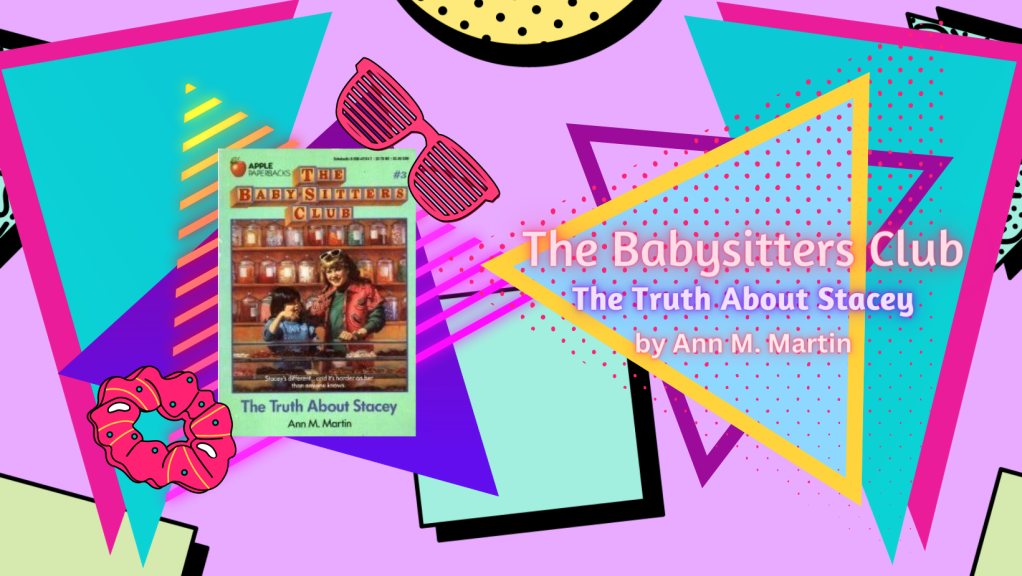
“Stacey’s different… and it’s harder on her than anyone knows.”
This review of The Babysitters Club #3: The Truth About Stacey is for Disability Book Week.
What age demographic is the book written for? Children and Middle Grade
Does the author self-identify as disabled? No/Unknown
What disability is discussed in the book? Type 1 Diabetes
Does the book follow the APA Style Guide for disability language? Yes
I started reading The Babysitters Club When I was about 6 or 7 years old and it quickly became my favorite series. Many other elder millennials like me have written articles about the impact these books had on their childhoods, and my experience was similarly positive. While Asian-American children had representation in Claudia Kishi and budding lesbians had a role-model in Kristy Thomas, I was a chronically ill child who saw a character like me when I read about Stacey McGill. Stacy is a character with an invisible chronic illness: type 1 diabetes. I am calling this an invisible illness because other people don’t necessarily know about the illness unless they are told, and in Stacey’s case, she keeps her diagnosis a secret from her friends at first. The tagline on the cover of the book says, “Stacey’s different… and it’s harder on her than anyone knows.” This line felt comforting to me as a child because I was chronically ill but I didn’t receive a chronic diagnosis until I was 16 years old. It was incredibly difficult to explain my illness to other kids at school when I was a child, and often I had to resort to gross-out tactics when they asked me questions about my illness. I was different and I struggled to explain this to my classmates.
While I didn’t have type 1 diabetes as a child, I identified with Stacey for two reasons: first, her experience with chronic illness was extremely similar to mine, even if our specific diagnoses or symptoms were different. Second, my family has a genetic pre-disposition for type 2 diabetes, so I already had family members who had diabetes and I was used to the concept of insulin shots and glucose regulation. In fact, now that I’m an adult I have been diagnosed with pre-diabetes.
The plot of The Truth About Stacey follows both her struggle for agency when it comes to choosing her own doctors and a secondary story about the entire Babysitters Club’s encounter with a rival babysitting organization. I appreciate that the entire story does not revolve around Stacey’s illness as she clearly has things going on in her life that are not about having diabetes. With that said, however, Stacey’s fight for agency against the wishes of her parents and the sketchy doctors they want her to see feels really familiar. Many disabled people face unsolicited advice from both family members and strangers on a regular basis, and this story portrays that struggle well, and comes to a happy conclusion in which Stacey’s parents finally listen to her and agree to let her be a major decision maker in her own healthcare journey.
While The Truth About Stacey gives readers a pretty accurate representation of childhood disability and chronic illness, I can’t speak on later books in The Babysitters Club series. I haven’t read most of the series since I was a child, but I have heard that some of the later books (many of which were written by ghostwriters) are less accurate when they describe Stacey’s condition. The Truth About Stacey, however, stands out as a good individual story with accurate disability representation — something that was really lacking when I was growing up in the late 80s and early 90s. Aside from this book, most of the representation I saw in children’s literature described children as being “sickly” or similar, and didn’t give accurate and specific details about the character’s illness. Most of the self-representation I saw as a kid was in books like The Secret Garden and The Borrowers where the protagonist went to live in the countryside due to some sort of undefined illness that made city life too hard on them. Seeing details about a chronic illness like Stacey’s meant everything to me as a kid.


Leave a Reply